"Inventing on Priciple" is an evergreen presentation. It was astonishing in 2012 and it remains relevant today. Even if the live coding Brett presents was something implemented in every software workflow (it isn't), the demos aren't the point of the talk (as Brett hits around 35 minutes in), it's creating an immediate connection to what you're working on. Especially in backend development, the push of dev-ops concerns into the creator's workflow limits how quickly we can build. The goal of microservices was to limit the inter service dependencies, but except in giant development organizations, this leads to engineers having to have bigger and beefier laptops to run all the services. Same goes for kubernetes. Architectures and frameworks are important, but we must preserve the connection between author and work.
In order to get a flavor of Brett's talk, I reimplemented portions of his live coder and found the original source he loaded to build the tree.
Live Coding Editor
A core realization Brett shows us is we program computers as a relic from earlier ages. From punch card programming, we have a true disconnect. Where the program must be entirely realized in the mind of the programmer, encoded into a series of punch cards, loaded into a computer, evaluated, and only then can the programmer examine the output. From there, we can think of how the development of languages proceeded and is still influenced by this and pervades our thinking. This is a core concept Bret was led to discover by his principal. We consider the Read-Eval-Print-Loop to be some sort of ultimate goal. Indeed, this kind of tooling can reduce the time between creation and feedback, but Bret goes further and shows how we can reimagine different ways of programming if we start and looking at how our tools influence the creative process.
As programmers, we are bound by the tools and languages we use. Many of the decisions around the design of these were made in different computing eras. Earlier eras dealt with resource constraints and designed their systems around these. So many of these constraints affected the way we created. Disk space, network bandwidth, CPU, GPU, caching, multiple cores, high resoultion display. All have fundamentally changed over the past decades.
That being said, those demos had such a high
Part 1: the Tree Demo
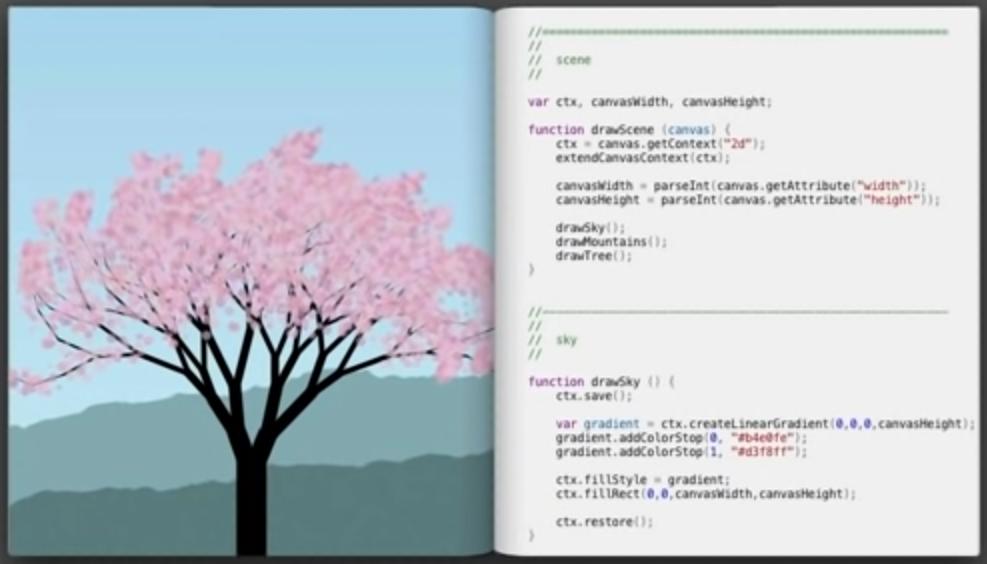
This demo shows off an IDE which has an immediate connection to what is being rendered. Bret demonstrates creating a scene in a JavaScript canvas.
The essential aspect of this code is to have the render of the code happen as the code is being written.
Think of compilation as an animation loop
With JavaScript, we are dealing with interpreted code. We are still constrained by the Code-Reload-Examine loop. In order to remove the "Reload" aspect of this, we should think of compilation as a coninuous act, not as an event we trigger. This is where we can be wasteful with CPU in order to realize a new way to interaction. Being able to make this core element happen, we can reimagine an animation loop running which constantly re-renders our code. Part of Bret's demo lead to this way of thinking very easily.
Better Yet, Think of compilation as a very frequent event
The problem with continuous compilation is unintended consequences while typing. Imagine executing a SQL statement on every key press.
Let's see.
DELETE FROM foo WHERE....
Wait why does't foo have any data?
In case it's not obvious, running SQL on every key press would be a disaster. DELETE FROM foo is valid
but disatrous and not the author's intention.
I Didn't Miss The Point
Bret's ultimate goal was not to demo his software, it was to show how the principal Bret had created for himself, "creators need an immediate connection to what they are creating" led him to reimagine interactions programmers have with computers. The ultimate goal of Bret's demos were not to show off the program used in the demo, but to demonstrate how his principal led him to create that tool. I think that's why he (as far as I know) hasn't released his tools. They aren't the point. They're just entralling demos.
posted 2022-11-29